An automated framework to study secondary nucleation and growth kinetics in inorganic salts
Quantifying crystal nucleation and growth kinetics is key for crystallization design, but conventional methods are slow, material-intensive, and hard to standardize.
In this article, we highlight a very recent study [1] that presents an automated framework to estimate secondary nucleation and growth kinetics of inorganic salts, combining small-scale experiments, in situ imaging, and population balance modeling extended to strong electrolytes via activity-based supersaturation. Demonstrated for potassium chloride and sulfate in ethanol–water mixtures, the method enables rapid and reproducible kinetic comparison.
About antisolvent crystallization of inorganic salts
Antisolvent crystallization of inorganic salts is widely used in separation, hydrometallurgy, and water treatment, but design often ignores kinetics. Literature data are scarce and hard to compare, and strong electrolytes add complexity via non-ideal behavior. This study presented below proposes an automated workflow for organics to inorganic salts, enabling standardized kinetic estimation and cross-system comparison.
Experimental setup
Crystallization experiments were carried out in the Crystalline system with controlled temperature, stirring, and in situ imaging.
Potassium chloride and potassium sulfate were crystallized from water and 25 wt% ethanol–water mixtures. Solubility data obtained isothermally at 25 °C were used to design experiments at different initial supersaturations. Automated heating–cooling cycles in sealed 8 mL vials induced repeated dissolution and crystallization while real-time images of crystal number and size were collected. A constant stirring speed of 1000 rpm ensured homogeneous suspension, and images were captured at a magnification of 4 µm/pixel.
Representative images were used to assess crystal morphology and confirm low aspect ratios and minimal agglomeration, as shown in Figure 1. The image data were processed to extract population moments, which were analyzed using a population balance model incorporating activity coefficients for strong electrolytes.
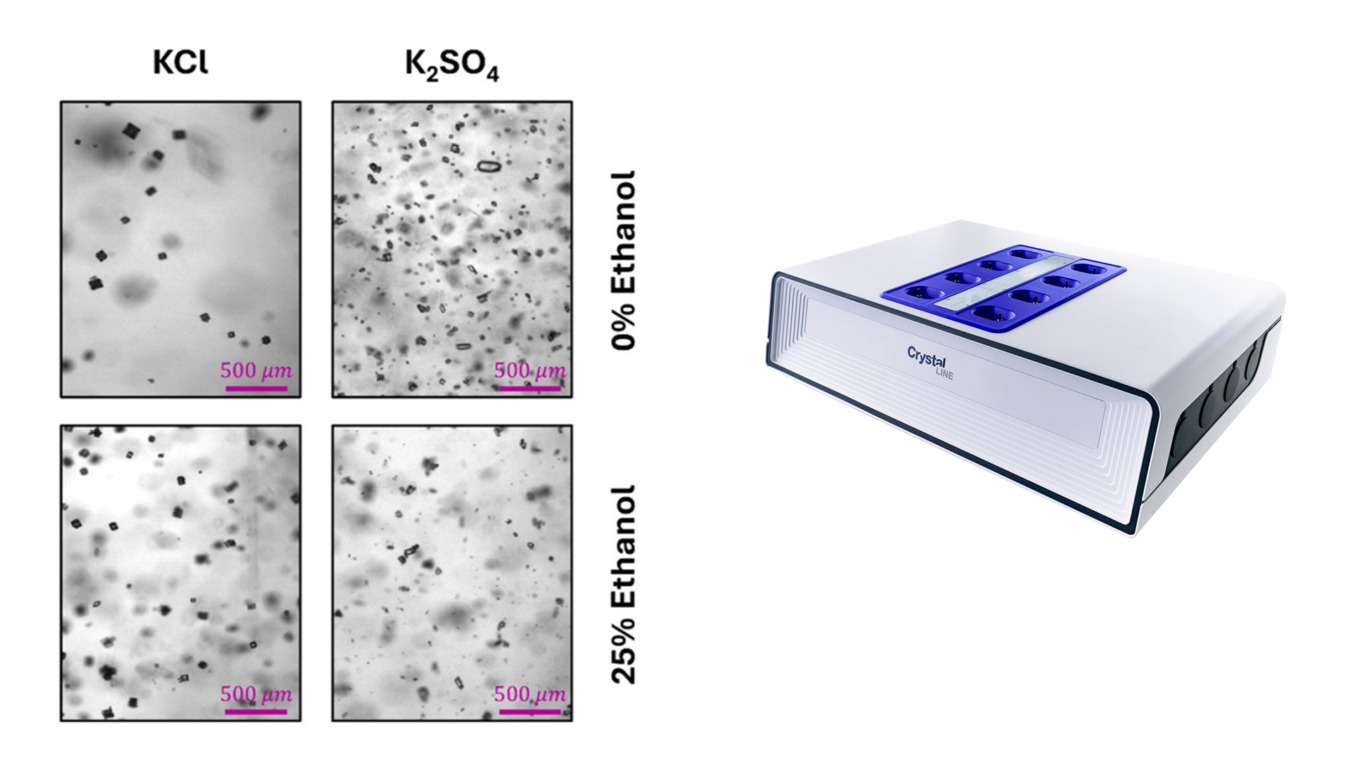
Figure1: In situ images from Crystalline
Results
Rapid cooling to the crystallization temperature triggered immediate secondary nucleation, resulting in a sharp increase in crystal number. As crystallization progressed, supersaturation decreased due to solute consumption while the solid concentration increased toward equilibrium. The smooth experimental trends observed within the selected low-overlap analysis window confirm the suitability of the population balance model for reliable kinetic parameter estimation, as shown in Figure 2.
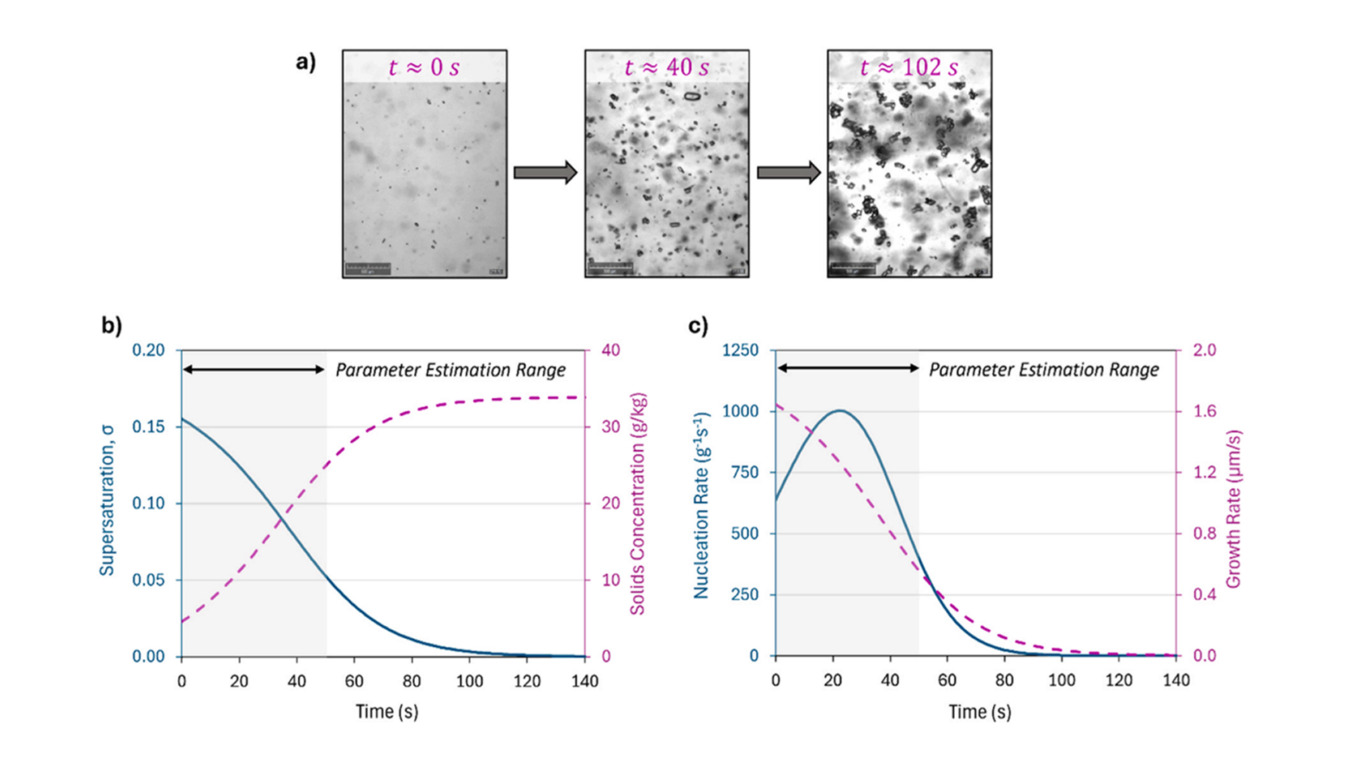
Figure 2: Model trends over the parameter estimation range. (a) Suspension images at different times. (b) Supersaturation and solids concentration. (c) Nucleation and growth rates. Gray areas show the estimation range, ending at image saturation.
The estimated kinetic parameters, summarized in Figure 3, demonstrate clear differences between the two salts and solvent systems. Potassium chloride exhibited significantly higher nucleation and growth rate constants than potassium sulfate, with differences on the order of one magnitude. For both salts, the presence of ethanol reduced nucleation and growth constants compared to pure water, indicating kinetic inhibition by the antisolvent beyond its impact on solubility.
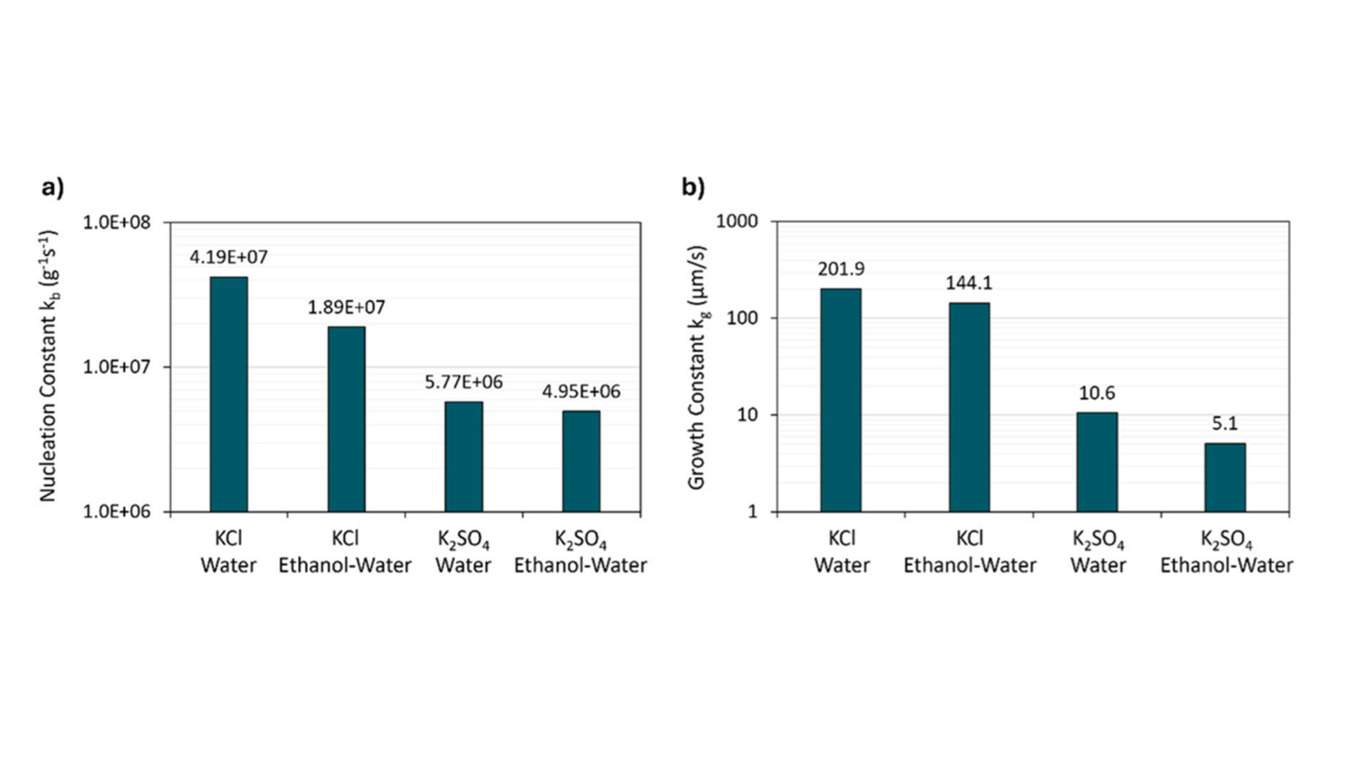
Figure 3: Estimated nucleation and growth parameters for four solute–solvent systems. (a) Secondary nucleation constants. (b) 1D crystal growth constants.
Conclusion
An automated and standardized methodology for estimating crystallization kinetics of inorganic salts was demonstrated using the Crystalline system. By integrating in situ imaging, population balance modeling, and electrolyte activity coefficients, the approach enables rapid and reproducible comparison of nucleation and growth kinetics across different salts and solvent environments, providing a practical tool for crystallization process design and optimization.
References
We thank the authors for their valuable contributions and insights!
[1] Parul Sahu, Joshua Zaharof, Kennedy Tomlinson, Gerard Capellades. Automated and standardizable approach to quantify crystal nucleation and growth kinetics: Extension to inorganic salts, Chemical Engineering Research and Design, Volume 222, 2025, Pages 532-543, ISSN 0263-8762, https://doi.org/10.1016/j.cherd.2025.09.029.
See the Crystalline in action
Book a demo - online or in your lab.