Introduction
Chemical reactions evolve over time, so time-course data are essential for understanding reaction rates and mechanisms. However, manual sampling is time-consuming and variable, while conventional automated reactors often require more material and may have mixing limitations. To address these challenges, the ReactALL platform combines automated sampling, overhead stirring, small reaction volumes, and parallel experimentation. It contains five independent reactors with an operating volume of approximately 5 mL, enabling efficient collection of reproducible kinetic data while reducing material consumption.
This study evaluates ReactALL through three pharmaceutical process-development case studies involving amide coupling from Sanofi, Pd-catalyzed Suzuki–Miyaura coupling from MSD, and SNAr reactions from Pfizer. The study also compares ReactALL data with established laboratory reactor systems and demonstrates its potential for efficient kinetic analysis, mechanistic understanding, and process optimization with less material.
Case Study 1: Rapid Amidation of Atuzabrutinib
The first case study investigated the amide coupling reaction in the synthesis of atuzabrutinib, in which amine reacts with carboxylic acid in the presence of EDCI·HCl to form atuzabrutinib. Initial experiments showed incomplete conversion, product degradation, and precipitate formation, causing reactor fouling and unreliable sampling. Parallel time-course experiments with different reaction conditions were therefore performed using ReactALL and monitored by UPLC-MS. Experiment A (MeTHF) caused significant fouling due to poor solubility of product and byproducts. Experiment B (THF + 1:1 MeCN/H₂O quench) reduced fouling but gave only 66% yield. Experiment C (1:4 MeCN/THF) produced a homogeneous reaction, minimized fouling, and increased the yield to 95%, as shown in Figure 1. Experiment D (−5 °C) slowed the reaction without improving yield, so Experiment C was selected. Each experiment used only 200–250 mg of starting material in a 5 mL reactor, achieving an 8–10-fold reduction in material consumption while producing kinetic profiles consistent with those obtained in the larger 50 mL commercial reactor.
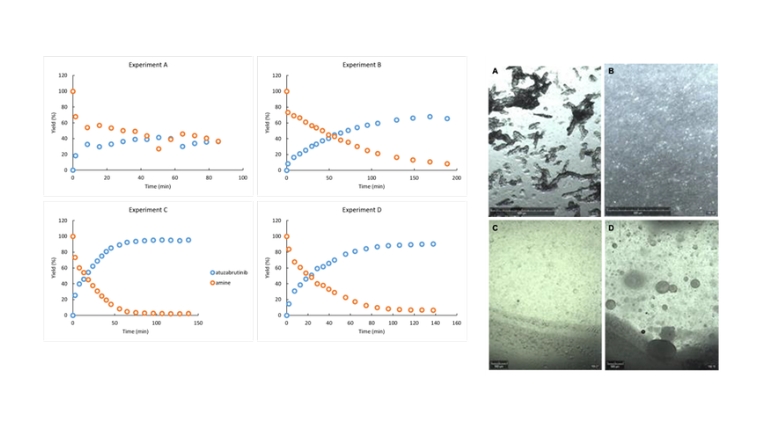
Figure 1: a) Optimization studies and kinetic data for the amidation reaction at different reaction conditions and b) End-of-reaction images from ReactALL
Case Study 2: Pd-Catalyzed Suzuki–Miyaura Coupling
The second case study investigated a biphasic Pd-catalyzed Suzuki–Miyaura C(sp²)–C(sp²) coupling reaction using the ReactALL platform. First, kinetic experiments were performed on a high-throughput platform using Variable Time Normalization Analysis (VTNA).
The results showed reaction orders of 0.4 for catalyst, 0 for aryl bromide, and 0.5 for aryl boronic acid. The excess experiment indicated catalyst deactivation or product inhibition, suggesting that transmetalation was likely turnover-limiting step. The same experiments were then performed using ReactALL, with reactions prepared in a glovebox and sealed using SmartCaps.
ReactALL showed reaction orders of 0.5 for catalyst, 0 for aryl bromide, and 0.5 for aryl boronic acid, as shown in Figure 2. The excess experiment again indicated catalyst deactivation or product inhibition. Although the absolute reaction rate was higher in ReactALL, likely due to improved overhead stirring and phase mixing, the kinetic trends were consistent between both platforms. Overall, the results demonstrated that ReactALL can provide reliable kinetic data for biphasic reactions while offering better control of reaction hydrodynamics.
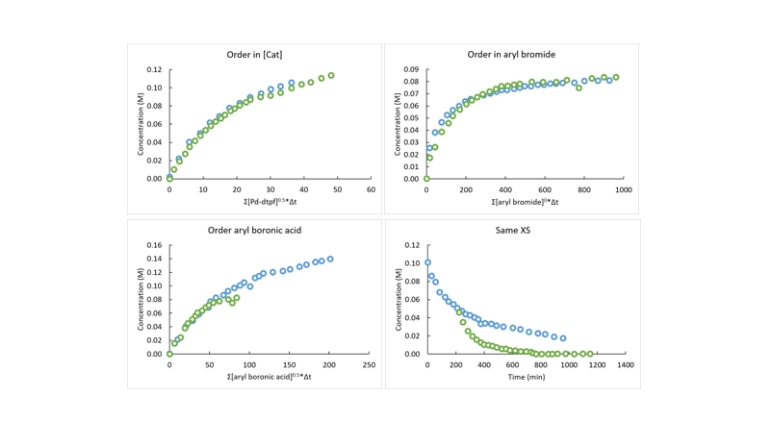
Figure 2: Time-course reaction profiles of a biphasic Pd-catalyzed cross-coupling reaction collected using ReactALL.
Case Study 3: Kinetic Modeling of an SNAr Reaction
The third case study investigated the SNAr reaction used to synthesize a key intermediate of abrocitinib from amine salt and aryl chloride. The reaction required about 48 h and was performed at high concentration (0.54 M) to improve throughput and reduce process maas intensity.
Five ReactALL experiments were first performed to compare time-course profiles with those obtained from a 250 mL commercial reactor using manual sampling. The ReactALL profiles closely matched 250 ml reactor data, while providing more detailed monitoring and maintaining a tighter Tj–Tr gap of 1–2 K.
An initial kinetic model showed overall second-order behavior but had limited agreement because the original DOE covered only 70–87 °C. A new set of five ReactALL experiments was therefore performed at 80, 65, 50 °C, higher DIPEA, and higher IPA volume to improve kinetic modelling, as shown in Figure 3. The refined model gave k = 1.934 × 10⁻⁴ L mol⁻¹ s⁻¹ at 65 °C and Ea = 62.62 kJ mol⁻¹, with good agreement between experimental and predicted data. Model predictions showed that temperature was the dominant factor, while higher concentration increased reaction rate; five ReactALL reactions required only 3.3% of the material used in 250 mL commercial reactor.
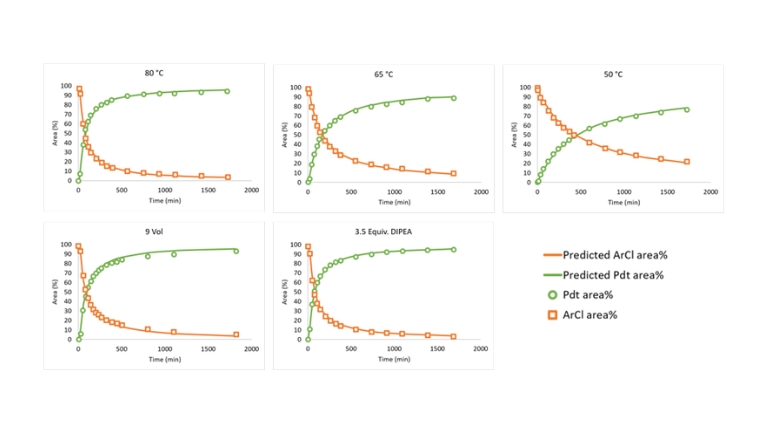
Figure 3: Model fit across trained experimental data at different reaction conditions.
Conclusion
Overall, the study demonstrates that ReactALL can generate laboratory-quality kinetic data while using substantially less material and increasing experimental throughput. These capabilities could make data-rich kinetic analysis more accessible during early-stage process development, when material is often limited and experimental decisions can strongly influence later manufacturing processes.
Reference
We thank the authors for their valuable contributions and insights!
[1] Nair, V. N., Rötheli, A. R., Cherney, A. H., Deem, M. C., Christensen, M., Stone, K., ... & Nguyen, T. N. (2026). Case Studies on Enabling Data-Rich, Parallelized Kinetic Analysis for Process Optimization with the ReactALL Platform. Organic Process Research & Development.