Automated secondary nucleation and crystal growth constant screening at small scale
We’re excited to introduce the new Population Balance Modelling (PBM) feature on the Crystalline instrument. With PBM, you can now calculate secondary nucleation and crystal growth constants at the millilitre scale, enabling rapid screening of solvents and conditions. This empowers you to understand your process earlier in development and select optimal conditions to favour either growth or nucleation. By leveraging this feature, researchers can accelerate decision-making, reduce reliance on large-scale trials, and fine-tune crystallization parameters with precision while saving time and material.
Introduction
Crystallization is a commonly used process in a wide range of industries including pharmaceuticals, agrochemicals and cosmetics. Despite this, it still remains a complex and challenging process with multiple competing factors such as agglomeration, growth and nucleation. There are several strategies and technologies that allow for better understanding and increasing control of a crystallization process. Population balance modeling is one of the strategies used, as it models the change in size and number of crystals at any point in the crystallization process, which can then be optimized to give the desired size distribution. From these models, secondary nucleation and growth constants can be calculated, providing deeper insight into a molecule’s crystallization behavior and enabling more effective process optimization.
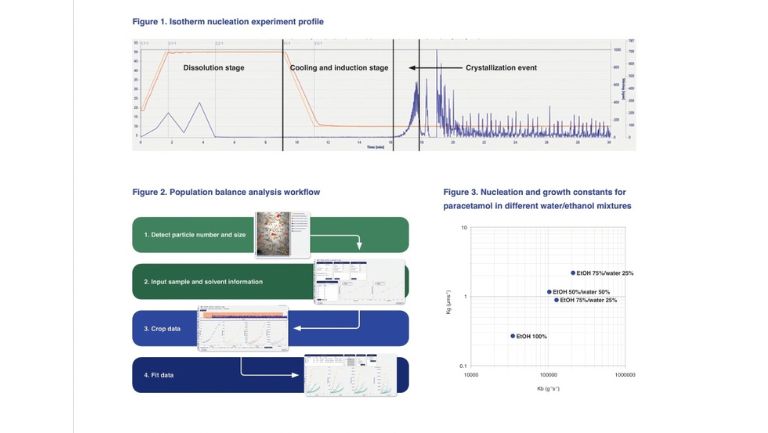
The new population balance modelling on Crystalline calculates the nucleation and growth constants of crystallization is a powerful way to understand how to achieve the required particle size distribution. Traditionally, population balance models are employed in the later stages of crystallization process development due to their scale dependency and high material and time requirements. As a result, critical process parameters, such as solvent composition, are often already established before kinetic modeling begins. The Crystalline platform overcomes these limitations by enabling the calculation of nucleation and crystal growth kinetics at the milliliter scale, using a methodology based on the work of Capellades et al. [1]. Utilizing the standardized high-resolution cameras, particle detection and size analysis, a simplified population balance model can be applied to calculate nucleation and growth constants from as few as 3 experiments and a few 100 mg of material.

Case study 1: Solvent selection for faster nucleation rate
To demonstrate the capability of deriving nucleation and growth rate constants from milligram-scale experiments, the effect of solvent composition on the crystallization behavior of paracetamol was investigated. This solvent combination presents negligible differences in refractive index between solvent and antisolvent, thus providing the most accurate representation of solvent effects on kinetics. The results of these experiments and analysis are shown in Figure 3.[2]. The results show that crystallization from pure EtOH had much lower growth and nucleation constants than any EtOH/water mixtures tested, both being ~10X lower. Additionally, these results show that increasing alcohol percentage decreases both nucleation and kinetic behavior. These results show that for the same supersaturation, higher levels of water promotes kinetics. Therefore, nucleation and growth can be optimized through controlling the amounts of water used.
Case Study 2: Solvent selection for desired particle size
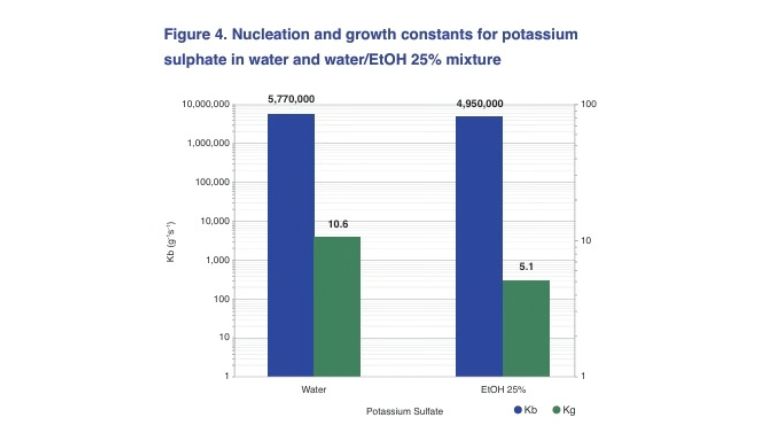
The second case study investigates the effect solvent composition has on the crystallization of potassium sulfate. Two samples were studied in pure solvent (water) and a mixture with 25% antisolvent (EtOH). These results are shown in Figure 4.[3].
Analysis of the nucleation and growth constants for potassium sulfate showed that the nucleation behavior was unaffected by the change in solvent composition. However, the growth constant in pure solvent was 2X higher than the antisolvent mixture showing a suppression of crystal growth. This can be used to optimize the final particle size distribution of a crystallization, where if larger particles are required then a crystallization from water would be used, however if smaller particle size was needed then crystallization with an antisolvent mixture should be selected.
Conclusions
The Crystalline instrument is a powerful tool in crystallization development, allowing for particle size, number and shape analysis in real-time at mL scale. This enables critical process decisions to be made earlier in a molecule’s development cycle, accelerating initial process development. The new population balance analysis feature on the Crystalline allows the use of the data generated to calculate scale-dependent growth rate (Kg) and nucleation rate (Kb) constants, values that are typically only available in later stages of development.
The use and application of the population balance feature has been demonstrated on the crystallization of two compounds to understand the effect solvent composition has on the nucleating and growth behavior. The results for paracetamol showed that any mixture of solvent antisolvent tested gave greater nucleation and growth behavior by ~10X compared to pure solvent. Additionally, the study of potassium sulfate showed that whilst nucleation behavior was unaffected by the change in solvent composition the growth constant was 2X higher in the pure solvent, allowing for solvent selection for larger or smaller particles respectively.
This new methodology to reveal the crystallization behavior of a molecule in different solvents can empower scientists to identify potential challenges earlier, screen solvents to optimize growth and nucleation as well as make informed decisions on crucial process parameters.
References
1 Automated and Material-Sparing Workflow for the Measurement of Crystal Nucleation and Growth Kinetics; Ryan J. Arruda, Paul A.J. Cally, Anthony Wylie, Nisha Shah, Ibrahim Joel, Zachary A. Leff, Alexander Clark, Griffin Fountain, Layane Neves, Joseph Kratz, Alpana A. Thorat, Ivan Marziano, Peter R. Rose, Kevin P. Girard, and Gerard Capellades; Crystal Growth & Design 2023, 23, (5), 3845-3861; DOI: 10.1021/acs.cgd.3c00252
2 Solvent Effects on Crystallization Kinetics: Investigating Trends across Scales; Ibrahim Joel, Alpana A. Thorat, Kevin P. Girard, Gerard Capellades, Methods, and Process Analytical Technologies. Org. Process Res. Dev. 21 November 2025; 29 (11): 2834–2845. https://doi.org/10.1021/acs.oprd.5c00282
3 Automated and standardizable approach to quantify crystal nucleation and growth kinetics: Extension to inorganic salts; Parul Sahu, Joshua Zaharof, Kennedy Tomlinson, Gerard Capellades, Chemical Engineering Research and Design, 2025, 222, 532-54 https://doi.org/10.1016/j.cherd.2025.09.029.
3 Automated and standardizable approach to quantify crystal nucleation and growth kinetics: Extension to inorganic salts; Parul Sahu, Joshua Zaharof, Kennedy Tomlinson, Gerard Capellades, Chemical Engineering Research and Design, 2025, 222, 532-54 https://doi.org/10.1016/j.cherd.2025.09.029.
Discover our new Population Balance Modelling feature
Curious how Crystalline and our new population balance modelling feature can help your organization? Contact us for a demo tailored to your needs!