Understanding crystallization kinetics
Understanding crystallization kinetics is essential for designing scalable pharmaceutical separation processes. This study examines the effect of solvent composition on nucleation and crystal growth kinetics of acetaminophen in ethanol–water mixtures using both small-scale batch and larger-scale MSMPR crystallization. Despite differences in scale and methodology, consistent solvent-dependent kinetic trends were observed, highlighting the usefulness of material-sparing experiments for early process development and scale-up.
Experimental methods
Acetaminophen crystallization was studied in ethanol–water solvent mixtures using two experimental approaches: (i) unseeded isothermal batch desupersaturation experiments at a 5 mL scale, with non-invasive imaging for particle size analysis, and (ii) continuous antisolvent MSMPR crystallization at a 300 mL scale with in situ chord length measurements. Solubility of acetaminophen in an ethanol−water solvent mixture was determined using both polythermal and isothermal techniques.
Vial-Scale Unseeded Isothermal Batch Crystallization
Unseeded batch desupersaturation experiments were performed at the vial scale using the Crystalline instrument. Crystallization was conducted in 8 mL glass vials containing approximately 5 mL of solution at 10 °C under constant agitation. Multiple initial supersaturation levels were investigated for each ethanol–water solvent composition. Particle counts and size distributions were obtained in situ through image analysis, and kinetic parameters for secondary nucleation and crystal growth were estimated using a population balance modeling approach.
Results and discussion
Solubility was found to increase with ethanol content, reaching a maximum at intermediate ethanol–water ratios. The effect of temperature on solubility was more pronounced in ethanol-rich mixtures than in pure water (Figure 1).
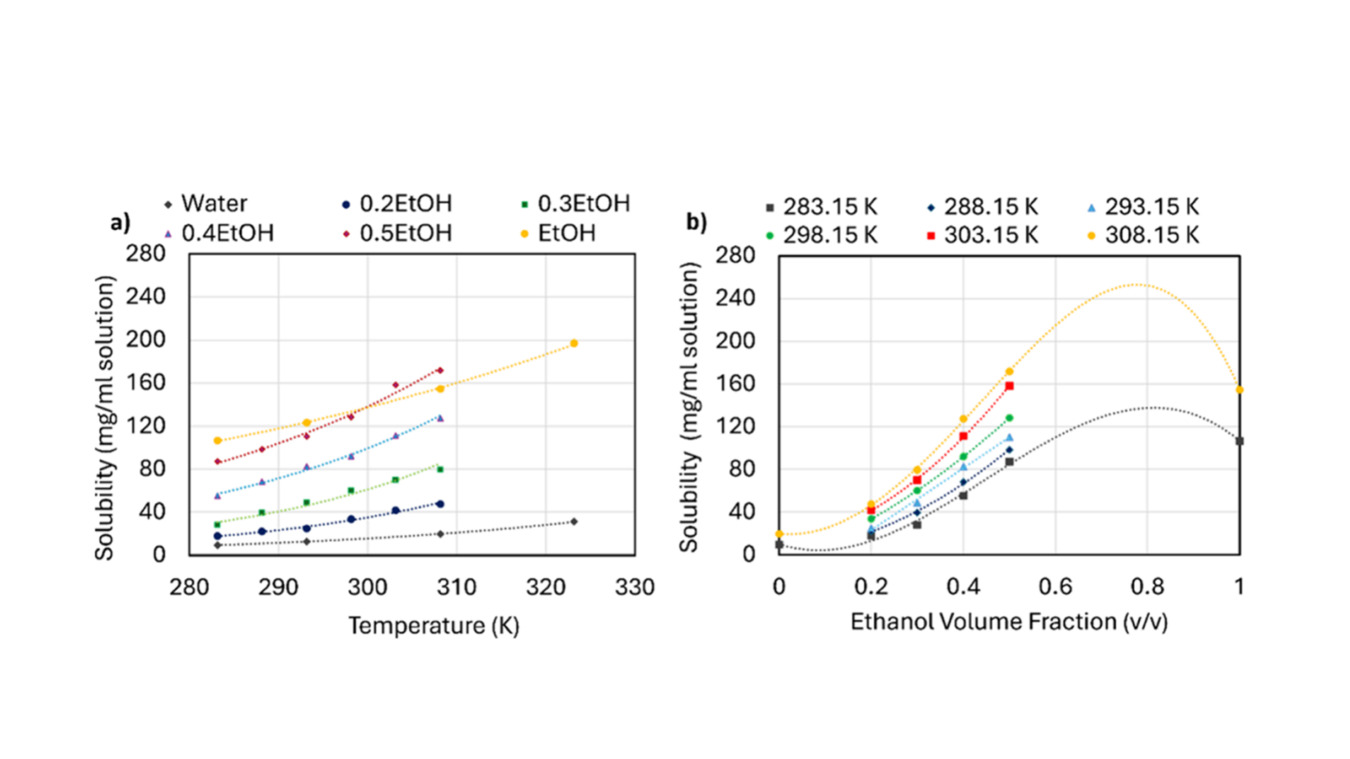
Figure 1: Solubility of acetaminophen in ethanol–water as a function of (a) solvent composition and (b) temperature.
Microscopic images of acetaminophen crystals obtained from vial-scale experiments using the Crystalline instrument reveal that crystal morphology was similar across all solvent compositions, as shown in Figure 2. This suggests that while solvent composition influenced crystallization kinetics, it had little effect on crystal shape
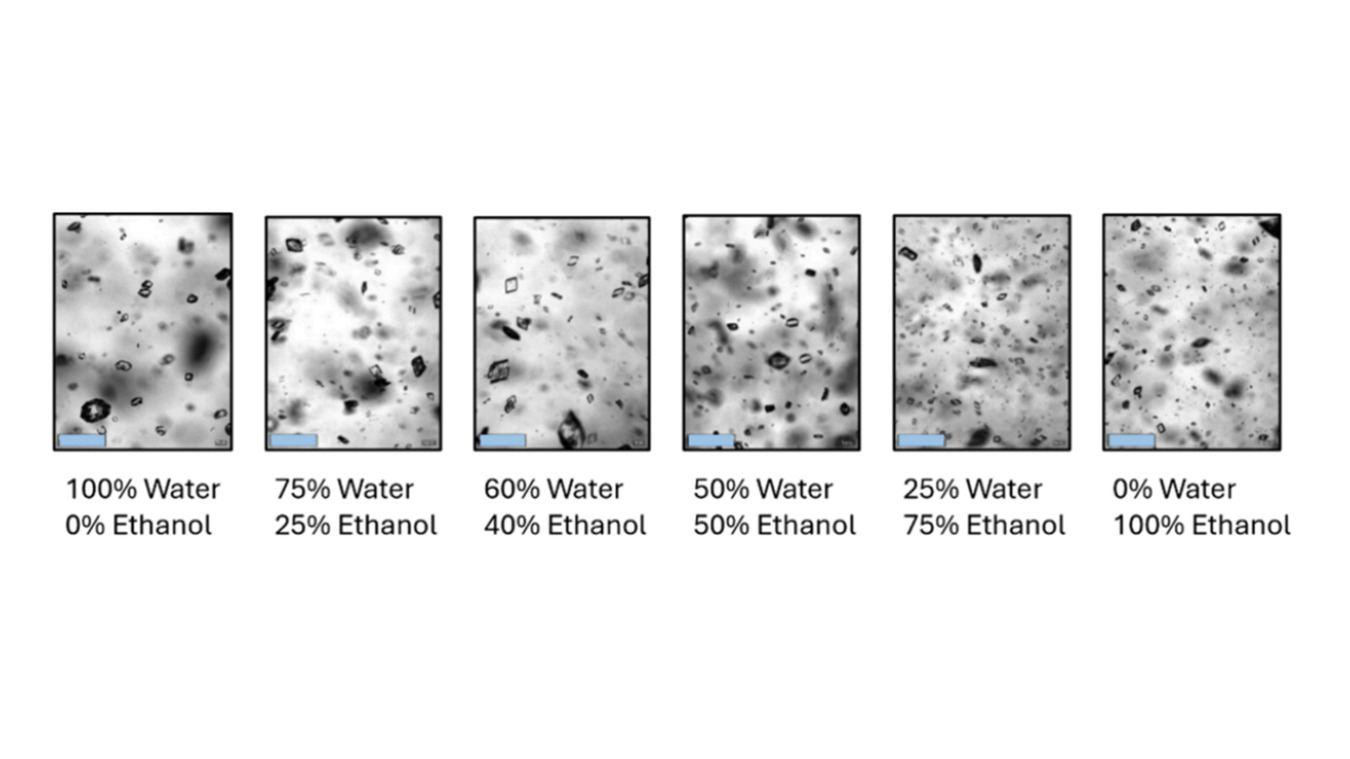
Figure 2: Microscopic images from Crystalline showing acetaminophen crystals in various ethanol–water fractions ~1 min after nucleation at 10 °C. Scale bars: 500 μm.
Both batch and MSMPR experiments showed that increasing ethanol fraction reduced nucleation and growth rates (Figure 3). While kinetic constants differed by orders of magnitude between methods, the relative ranking of solvent compositions was consistent. Differences were attributed to scale-dependent mixing, supersaturation ranges, and measurement techniques. Both approaches captured the same decreasing trend in crystal size, confirming robust solvent effects across methods.
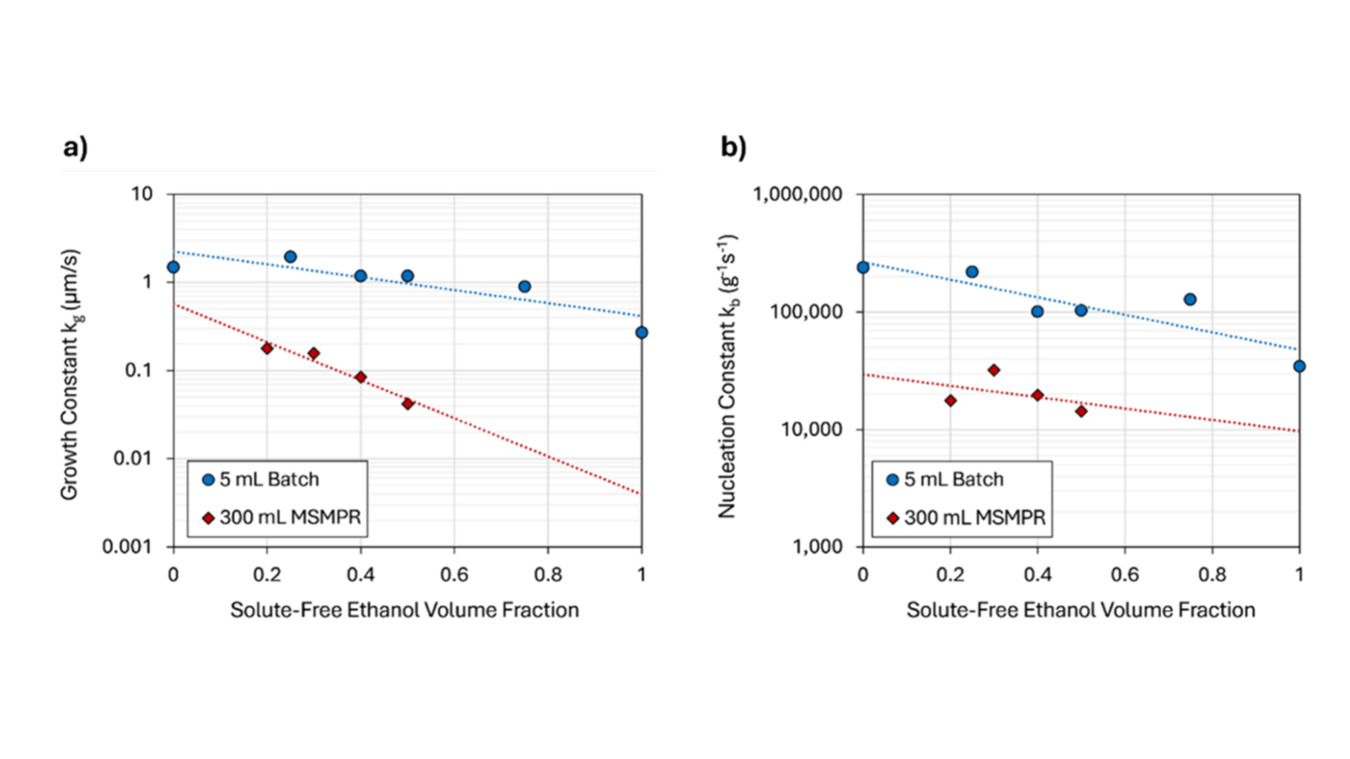
Figure 3: Solvent dependence of growth (a) and nucleation (b) constants from 5 mL batch (Crystalline) and 300 mL MSMPR experiments.
Conclusion
This study demonstrates that solvent-dependent crystallization kinetic trends are transferable across experimental scales and methods, despite differences in absolute parameter values. Small-scale, standardized experiments can therefore be effectively used to screen solvents and guide early process design, reducing time and material requirements before large-scale validation.
References
We thank the authors for their valuable contributions and insights!
Joel, Ibrahim and Thorat, Alpana A. and Girard, Kevin P. and Capellades, Gerard. Solvent Effects on Crystallization Kinetics: Investigating Trends across Scales, Methods, and Process Analytical Technologies. Organic Process Research & Development 2025 29 (11), 2834-2845, DOI: 10.1021/acs.oprd.5c00282
See the Crystalline in action
Book a demo - online or in your lab.