Abstract
The growing need for sustainable plastic waste management has increased interest in solvent-based recycling as an alternative to conventional recycling methods. Unlike mechanical recycling, solvent-based recycling selectively dissolves target polymers, enabling the efficient separation of contaminants, additives, and other plastics before polymer recovery. The success of this process depends on identifying solvents that provide high polymer solubility while meeting environmental, safety, and economic requirements. In this study, the solubility behavior of four polyethylene (PE) samples with different molecular weights and melting properties was experimentally investigated in ten solvents using the Crystal16 instrument. The experimental data were further used to evaluate the predictive capability of the SAFT-γ Mie group-contribution equation of state for modelling polyethylene solubility.
Experimental Procedure
Polyethylene (PE) solubility was determined using the Crystal16 automated multireactor crystallizer employing the polythermal method. Accurately weighed amounts of PE and solvent were placed in 1.5 mL sealed glass vials and initially heated to approximately 5 K below the polymer melting temperature until complete dissolution was achieved. The samples were then subjected to repeated heating and cooling cycles under continuous stirring at 700 rpm, and the clear-point temperature (100% solution transmissivity) was recorded. The average clear-point temperature from three consecutive cycles was taken as the equilibrium solid–liquid equilibrium (SLE) temperature. The measured solubility data were subsequently compared with predictions from the SAFT-γ Mie group-contribution equation of state to assess its capability for predicting polyethylene–solvent phase behavior.
Results
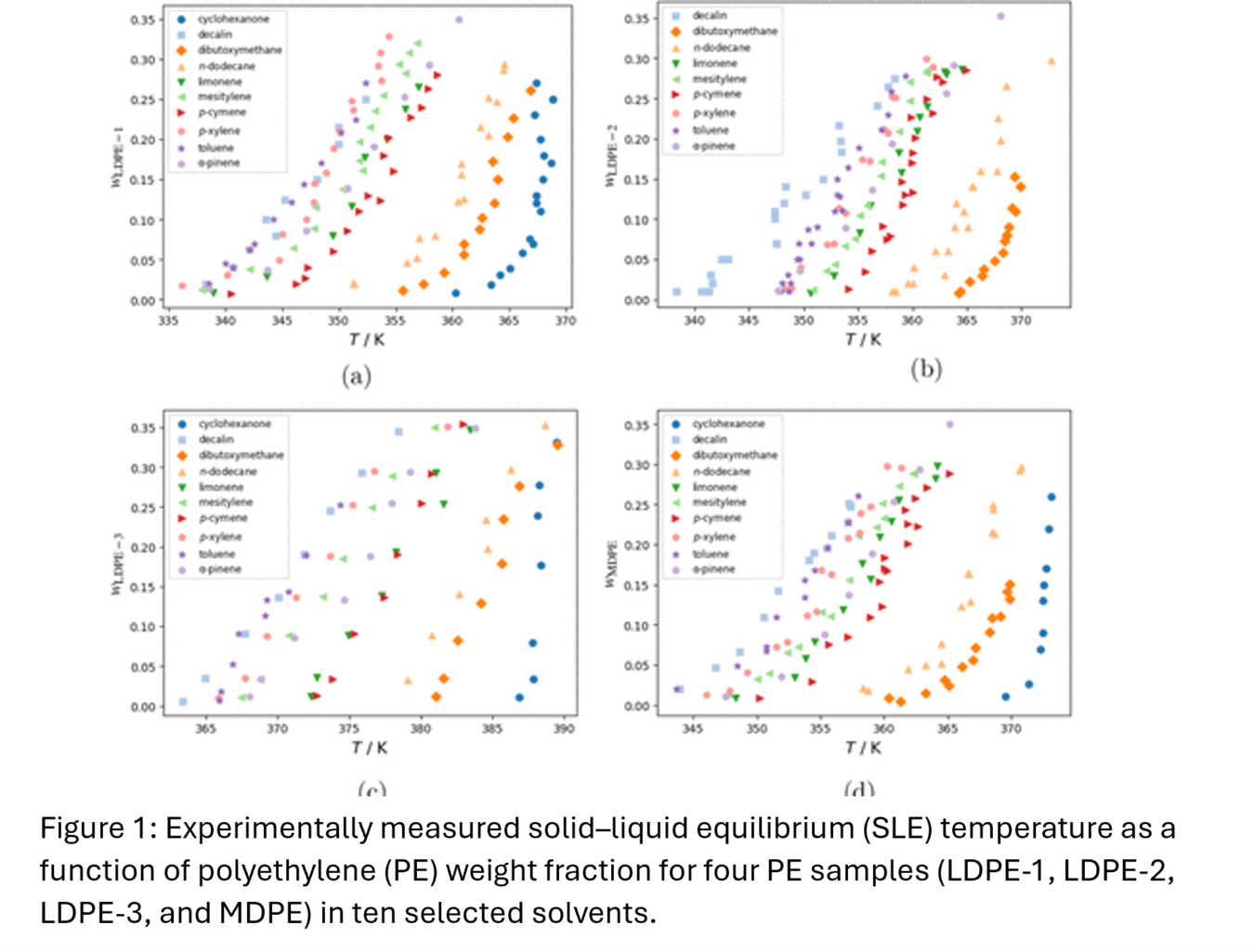
Figure 1 presents the experimentally measured solid–liquid equilibrium (SLE) temperatures of four polyethylene (PE) samples in ten selected solvents obtained using Crystal16. For all PE samples, the dissolution temperature increased with increasing polymer concentration, indicating lower solubility at higher polymer loadings. Among the solvents investigated, decalin, toluene, p-xylene, and mesitylene exhibited the lowest dissolution temperatures, demonstrating superior solvent performance, whereas n-dodecane, cyclohexanone, and dibutoxymethane showed comparatively lower PE solubility. Furthermore, LDPE-3 consistently required higher dissolution temperatures than the other PE samples because of its higher melting temperature.
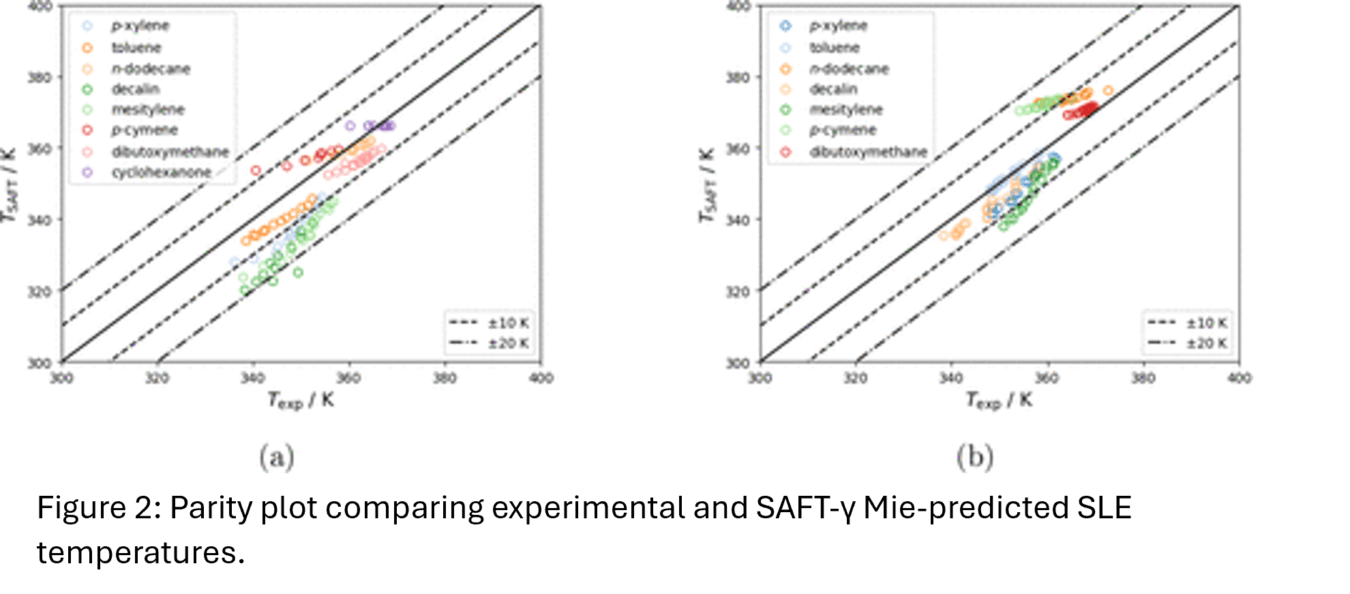
The experimental data generated using Crystal16 were successfully validated using the SAFT-γ Mie thermodynamic model. As shown in Figure 2, which presents a parity plot of predicted and measured SLE temperatures, most data points lie close to the parity line, indicating excellent agreement between the experimental measurements and model predictions.
Conclusion
This study provides comprehensive experimental and modelling data on polyethylene solubility relevant to solvent-based recycling processes. The results confirm that decalin and aromatic solvents remain highly effective, while several bio-derived solvents offer sustainable alternatives without significant loss of performance. The SAFT-γ Mie equation of state successfully predicted polyethylene solubility across multiple solvent systems. Overall, the combination of Crystal16 measurements and thermodynamic modelling provides an efficient approach for developing sustainable solvent-based recycling processes for polyethylene.
Reference
We thank the authors for their valuable contributions and insights!
[1] Standish, R., Yin, J., Burger, J., Jackson, G., Adjiman, C. S., Minceva, M., & Galindo, A. (2026). Investigating Polyethylene Solubility for Solvent-Based Recycling: Experiments and SAFT-γ Mie Predictions. Macromolecules.
Investigating solubility behavior with the Crystal16 instrument
Curious how Crystal16 can help your organization?
Get in touch with us!