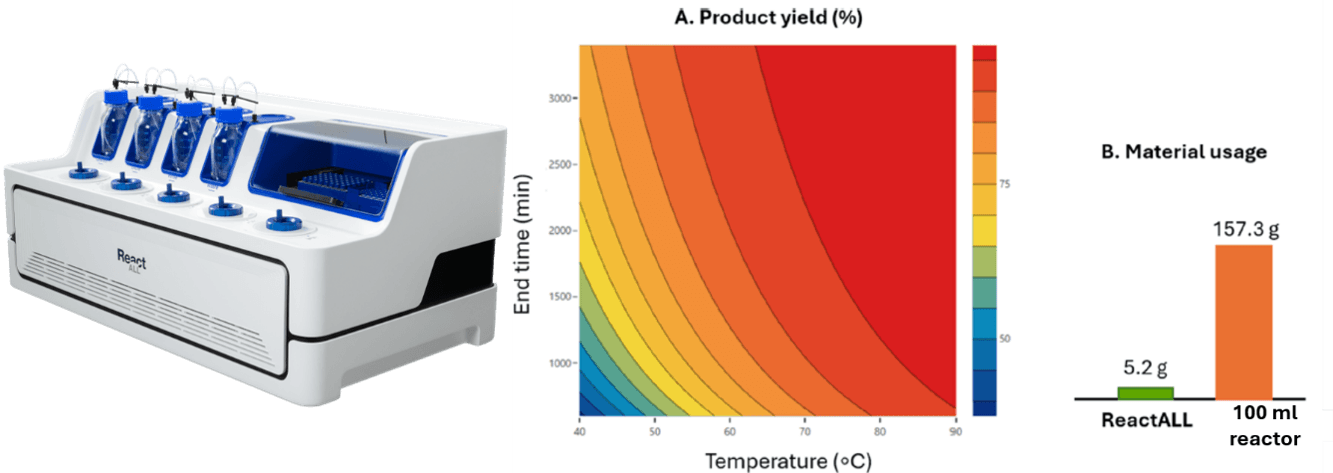
Figure 1 (A) Contour plots derived from the model. (B) Comparison of material usage between ReactALL and 100 ml Reactori
The Challenge:
In pharmaceutical process development, generating high-quality kinetic data is critical, yet traditional methods are constrained by material limitations, sampling inconsistencies, and artifacts caused by mixing. Automated laboratory reactors offer precision but typically demand large volumes and material, while smaller setups often sacrifice scale-predictive mixing. The result is compromised data, slower optimization, and wasted resources when materials are scarce.
ReactALL is a five-reactor platform with automated sampling designed provide data rich experimentation comparable with larger volumes, whilst working with little material. With a 5 mL working volume, overhead agitation, and built-in sampling, it delivers ALR-quality kinetic data using up to 40 times less material while boosting throughput fivefold, transforming early-stage development. Highlighted in this unprecedented collaborative paper between Pfizer, Merck and Sanofi are examples of the use of the ReactALL to revolutionizes workflows at early development.[i]
[i] Case Studies on Enabling Data-Rich, Parallelized Kinetic Analysis for Process Optimization with the ReactALL Platform; Vaishnavi N. Nair, Andreas R. Rötheli, Alan H. Cherney, Madeleine C. Deem, Melodie Christensen, Kevin Stone, Lu Han, Sebastien Monfette, and Truong N. Nguyen; Organic Process Research & Development Article ASAP; DOI: 10.1021/acs.oprd.6c00131
ReactALL
ReactALL’s design addresses the most persistent pain points in kinetic analysis. Its compact 5 mL reactors slash material consumption by over 10-fold compared to conventional systems, making it ideal for early-stage projects where API supply is limited. Overhead stirring ensures hydrodynamic control comparable to large-scale reactors, a critical feature validated across biphasic Suzuki-Miyaura couplings, slurries, and solid-forming SNAr reactions. The built-in sampling mechanism eliminates human error and guarantees representative aliquots, even in the presence of fouling or precipitation, with a consistent 5-minute cycle across all reactors. This automation not only improves data quality but also enables five parallel reactions, allowing teams to generate data-rich time-course profiles in a single day.
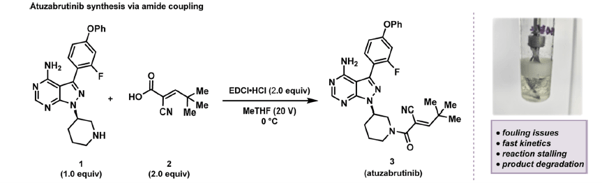
Figure 2 Atuzabrutinib synthesis via amide coupling.i
Industrial Case Studies
Sanofi used ReactALL to optimize an amidation reaction for atuzabrutinib synthesis, where fast kinetics and fouling had previously disrupted sampling and masked product degradation. The ReactALL identified an optimal solvent system (MeCN/THF) that eliminated fouling and achieved 95% yield, while using 8–10 times less material per run than traditional setups. Kinetic profiles collected on ReactALL closely matched those from a 50 mL reactor with automated sampling, confirming scale predictability.
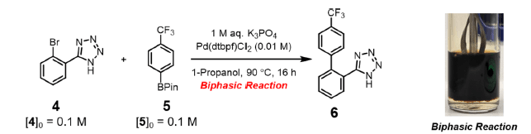
Figure 3 Biphasic Pd-catalyzed cross-coupling reaction.i
MSD applied ReactALL to a Pd-catalyzed Suzuki-Miyaura coupling, a biphasic reaction prone to catalyst inhibition and mass-transfer limitations. Variable Time Normalization Analysis revealed a fractional catalyst order of 0.5, suggesting dimeric resting states or deactivation. The platform’s overhead stirring improved mixing compared to magnetic stirring, yielding faster and more reliable kinetics. These insights provided clear direction for ligand optimization and cost reduction.
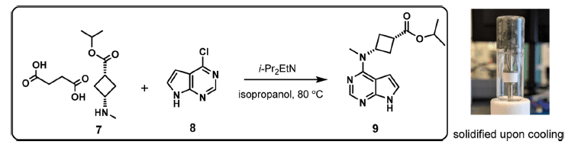
Figure 4 SNAr reaction with poor physical properties.i
Pfizer leveraged ReactALL to build a kinetic model for an SNAr reaction in abrocitinib synthesis. Despite the reaction’s slow pace and tendency to solidify upon cooling, the platform enabled a complete kinetic model to be constructed in a single day using parallel reactors. The model accurately predicted reaction behavior even outside the training range, with temperature emerging as the dominant factor. Notably, ReactALL used just 3.3% of the material required by a 100 ml reactor, without compromising data quality.
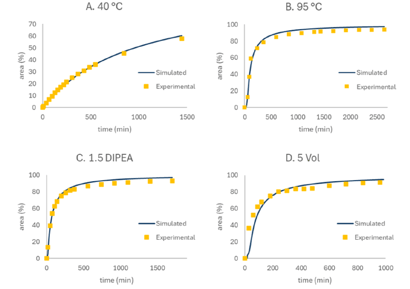
Figure 5 Predictive reaction profiles in various conditions.i
Why It Matters for Your Lab
ReactALL enables high-fidelity kinetic analysis by removing the barriers of material scarcity and throughput. Whether optimizing a coupling reaction, problem solving a biphasic cross-coupling, or building a predictive model, teams can now generate robust, scale-relevant data faster and at lower cost—without sacrificing quality or scalability.
Reference
[1] Case Studies on Enabling Data-Rich, Parallelized Kinetic Analysis for Process Optimization with the ReactALL Platform; Vaishnavi N. Nair, Andreas R. Rötheli, Alan H. Cherney, Madeleine C. Deem, Melodie Christensen, Kevin Stone, Lu Han, Sebastien Monfette, and Truong N. Nguyen; Organic Process Research & Development Article ASAP; DOI: 10.1021/acs.oprd.6c00131
ReactALL for faster and lower cost data
Curious how ReactALL can help your organization?
Contact us for a demo tailored to your needs!