Abstract
Polymorphism significantly influences the physical and chemical properties of crystalline pharmaceutical compounds, affecting solubility, stability, dissolution, and bioavailability. Mefenamic acid (MFA), a nonsteroidal anti-inflammatory drug, exists in multiple polymorphic forms with distinct molecular conformations. This study investigates the solvent-dependent stability of MFA Forms I and II in formamide and toluene using Crystalline systems integrated with Raman spectroscopic monitoring. The study demonstrates that solvent interactions influence not only crystallization kinetics but also the thermodynamic stability of polymorphs.
Experimental
Solution Raman Spectroscopy
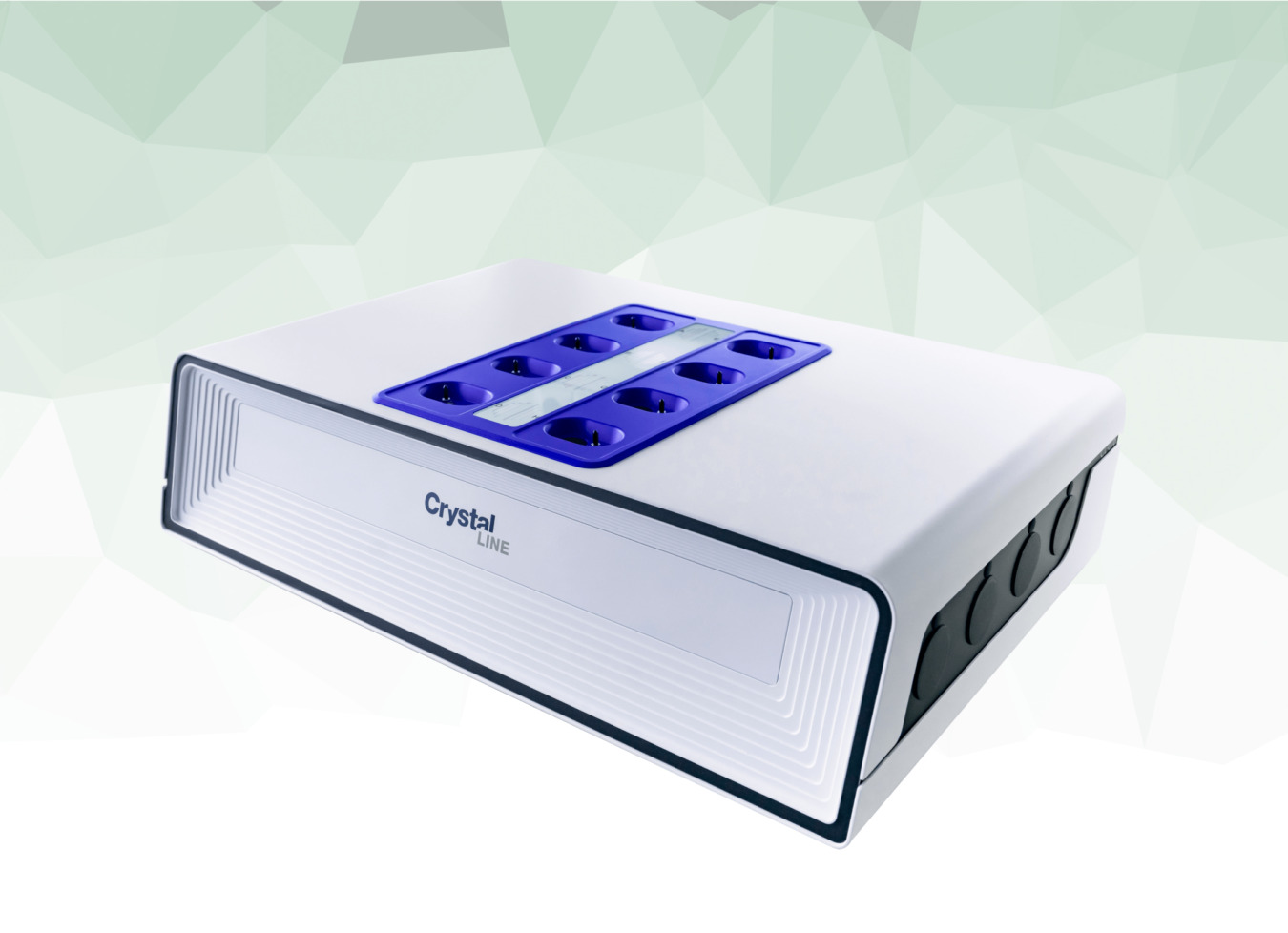
In-situ Raman spectroscopy was used for real-time monitoring of crystallization and polymorphic transitions. A HyperFlux PRO Plus 785 nm Raman instrument coupled with a Tornado Crystalline probe enabled direct identification of crystal forms during nucleation and growth without disturbing the crystallization process.
Solubility Experiment
Solubility experiments were performed using temperature-controlled Crystalline crystallization platforms to obtain accurate and reproducible solubility measurements of MFA Forms I and II. The system provided precise control of temperature, stirring, and cooling conditions for evaluating phase behavior in formamide and toluene over a temperature range of −5 °C to 35 °C. Equilibrium concentrations were determined using UV–visible spectroscopy.
Competition Slurry of MFA Forms I and II
For competition slurry experiments, saturated MFA solutions in formamide or toluene were filtered and transferred into 8 mL quartz vials. Equal amounts of MFA Form I and Form II crystals (300 mg each) were added to 5 mL of solution, and the slurries were maintained at controlled temperatures of −5 °C for formamide and −7 °C, −30 °C, or −80 °C for toluene. Raman spectra were recorded every consecutive day by placing the vial in a Crystalline instrument equipped with a Raman probe to study polymorph stability and transformation behavior
Results
The results demonstrated a strong solvent dependence on the relative stability of MFA polymorphs. Solubility measurements showed that Form II possesses higher solubility than Form I in toluene, confirming that Form I is the thermodynamically stable crystal form in this solvent. In formamide, however, the solubilities of Forms I and II became nearly identical at low temperatures, indicating a solvent-induced reversal of stability where Form II becomes the favored polymorph. Thermodynamic analysis further demonstrated that the Gibbs free energy difference between the two forms strongly depends on both solvent and temperature.
Competition slurry experiments performed at −5 °C in formamide confirmed that Form II gradually became the dominant polymorph, proving its enhanced stability under these conditions. In contrast, competition slurry experiments in toluene at −7 °C, −30 °C, and −80 °C demonstrated that Form I remained the stable polymorph across all tested temperatures as shown in figure 1. SS-NMR, PXRD, and microED analyses verified that the crystals remained neat polymorphs without solvent incorporation into the crystal lattice. Computational molecular dynamics simulations revealed that solvent-specific molecular conformations strongly influence nucleation behavior and crystal selection.
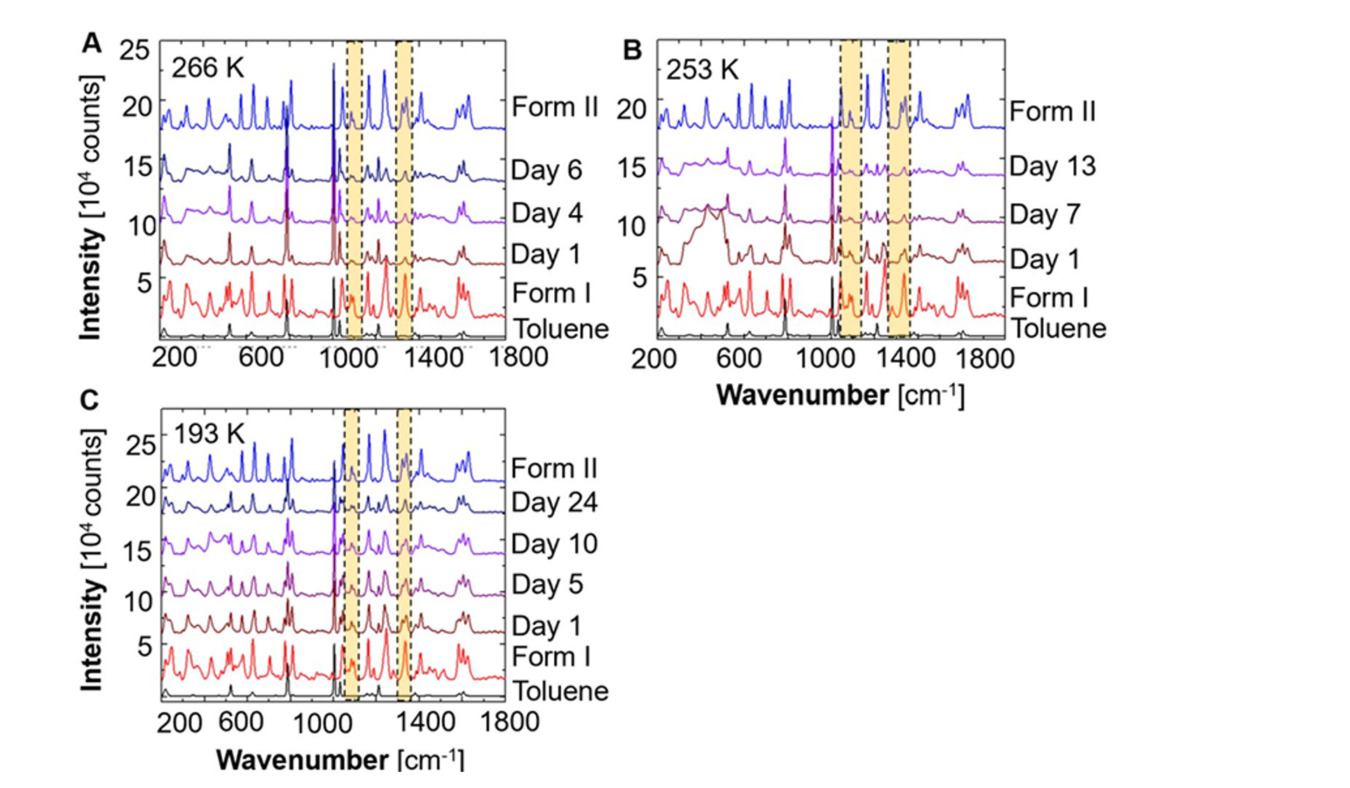
Figure 1: Competition slurry experiments of MFA Forms I and II in toluene at (A) 266 K, (B) 253 K, and (C) 193 K. Gold-highlighted regions between dashed lines indicate Raman bands characteristic of Forms I and II.
Conclusion
This study demonstrates that the relative thermodynamic stability of MFA polymorphs depends strongly on the solvent environment. Form II becomes more stable than Form I in formamide at low temperatures, whereas Form I remains stable in toluene. Experimental and computational analyses revealed that solvent-dependent conformational populations and molecular dynamics govern polymorph stability and crystallization outcomes. Overall, the findings provide valuable insight into controlling pharmaceutical polymorphism through solvent selection and highlight the importance of solvent-mediated interactions in crystal engineering and pharmaceutical manufacturing.
Reference
We thank the authors for their valuable contributions and insights!
[1] Yerragunta, M., Veliz, A. C., Pulluri, R., Campo, M. D., Guan, X., Rimer, J. D., ... & Vekilov, P. G. (2026). Solvent-Dependent Relative Stability of Crystal Forms. Crystal Growth & Design. Solvent-Dependent Relative Stability of Crystal Forms | Crystal Growth & DesignTop of Form
Curious to learn more?
Download the application note "Tracking Polymorph and Crystal Morphology".