About the webinar
Polymer solution phase behavior plays an important role in formulation, processing, and final material performance. However, identifying suitable solvents for a given application often requires extensive trial and error. Unlike small molecules, polymer systems are influenced by factors such as molar mass distribution, slow dissolution and precipitation kinetics, and sensitivity to experimental conditions, which can lead to variability in measured outcomes.
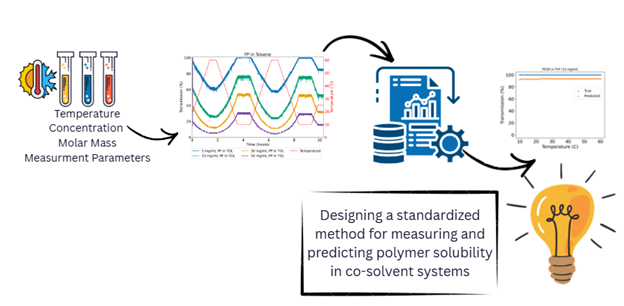
In this webinar, we present a standardized, medium-throughput methodology for measuring polymer solubility using the Crystal16. The workflow is designed to improve reproducibility and data quality by systematically controlling key experimental parameters, including temperature profiles, ramp rates, mixing conditions, and concentration.
Building on this framework, we demonstrate how transmission-based measurements can be used to generate solubility insights while capturing both thermodynamic and kinetic effects. These structured datasets can also support the development of machine learning models for predicting polymer–solvent behavior. The approach is further extended to co-solvent systems, where we introduce an experimental design strategy to efficiently screen solvent mixtures and identify regions of co-solvency and phase instability.
Attendees will learn how to:
- Implement a standardized workflow for polymer solubility measurements
- Design experimentsc that capture both thermodynamic and kinetic behavior
- Use high-throughput data to construct solubility maps across temperature and concentration
- Apply these methods to accelerate co-solvent system screening and formulation development
This work highlights how improved experimental consistency enables more reliable interpretation of polymer phase behavior and supports data-driven approaches to solvent selection and materials design.
Date: Thursday, 9 July 2026
Time: 4.00 pm CEST | 3.00 pm GMT | 10.00 am EDT | 7.00 am PDT | 7.30 pm IST