About the webinar
Poor aqueous solubility of many new chemical entities remains a significant obstacle in drug development, often limiting oral bioavailability and therapeutic efficacy. The amorphous form of an active pharmaceutical ingredient (API) is a powerful solution to address this issue, offering substantially improved apparent solubility and dissolution rates compared to crystalline counterparts. As such, the development of amorphous APIs is becoming increasingly important in biopharmaceutics and formulation science, enabling the progression of promising candidates with otherwise challenging physicochemical properties.
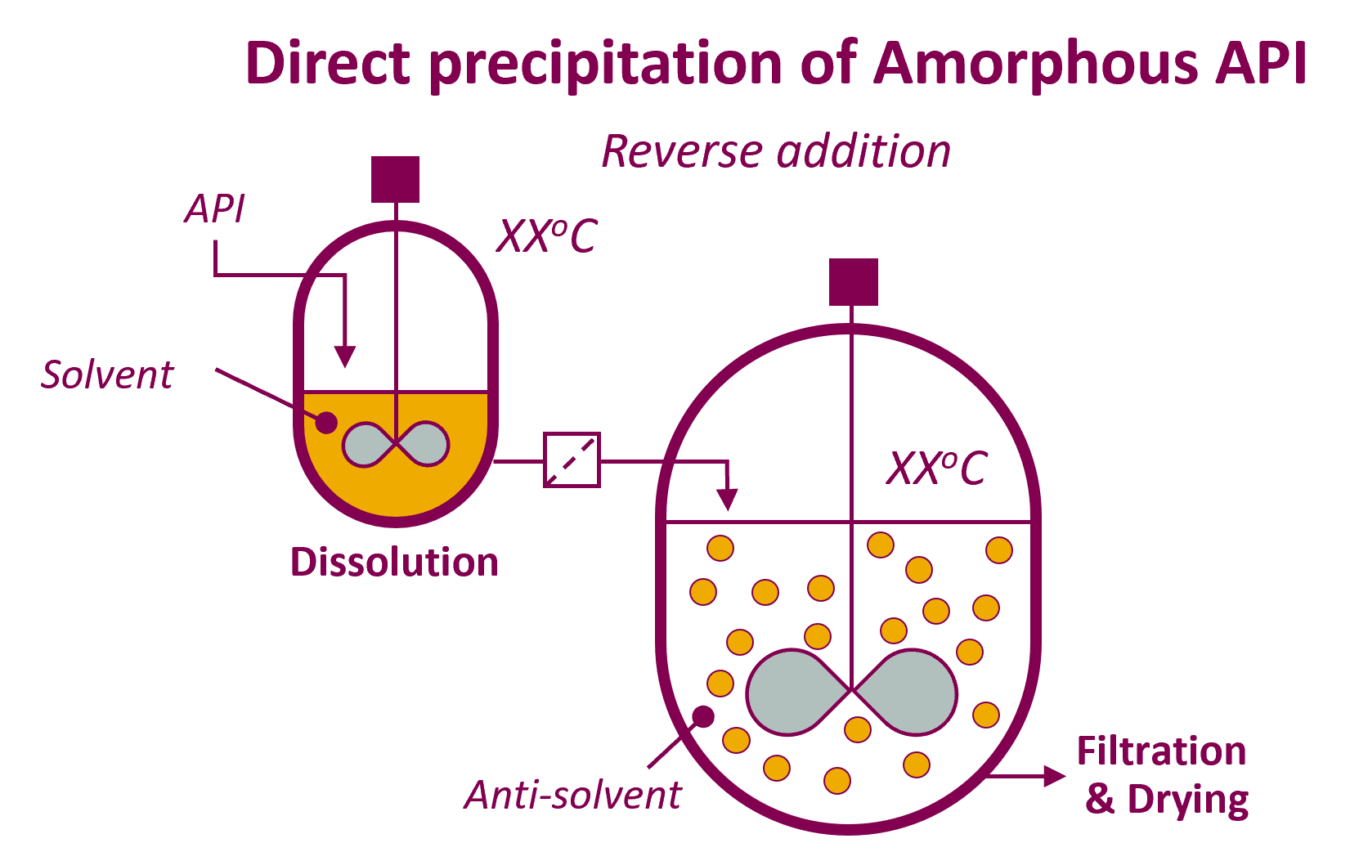
Despite the advantages, working with amorphous APIs presents a distinct set of scientific and technical challenges. The inherent thermodynamic instability of the amorphous state leads to a risk of crystallisation during processing, storage, and upon administration, which can undermine both efficacy and product shelf life. Additionally, amorphous materials often demonstrate increased hygroscopicity, challenging both downstream manufacturability and formulation robustness. From a process perspective, the generation of amorphous APIs requires the careful consideration of methods such as spray drying, melt quenching, or solution precipitation — each with its own advantages, limitations, and suitability for different molecular profiles.
These issues are particularly complex during early phase development, where limited material availability, time constraints, and evolving understanding of a compound’s physicochemical properties converge. Early amorphous development demands rapid, phase-appropriate risk assessment of physical stability, manufacturability, and bio performance — often with limited data. Moreover, there is a critical need to ensure the chosen amorphous approach is scalable and flexible enough to adapt as molecule understanding and formulation needs evolve during later development stages.
Join us on this free webinar with Dr. Alex Cousen, Senior API Scientist at AstraZeneca, UK.
Date: Thursday, 22 October 2026
Time: 4.00 pm CEST | 3.00 pm GMT | 10.00 am EDT | 7.00 am PDT | 7.30 pm IST